
Navigating the Crossroads: The Complex Outlook for the Victorian Property Market Through 2026 and 2027
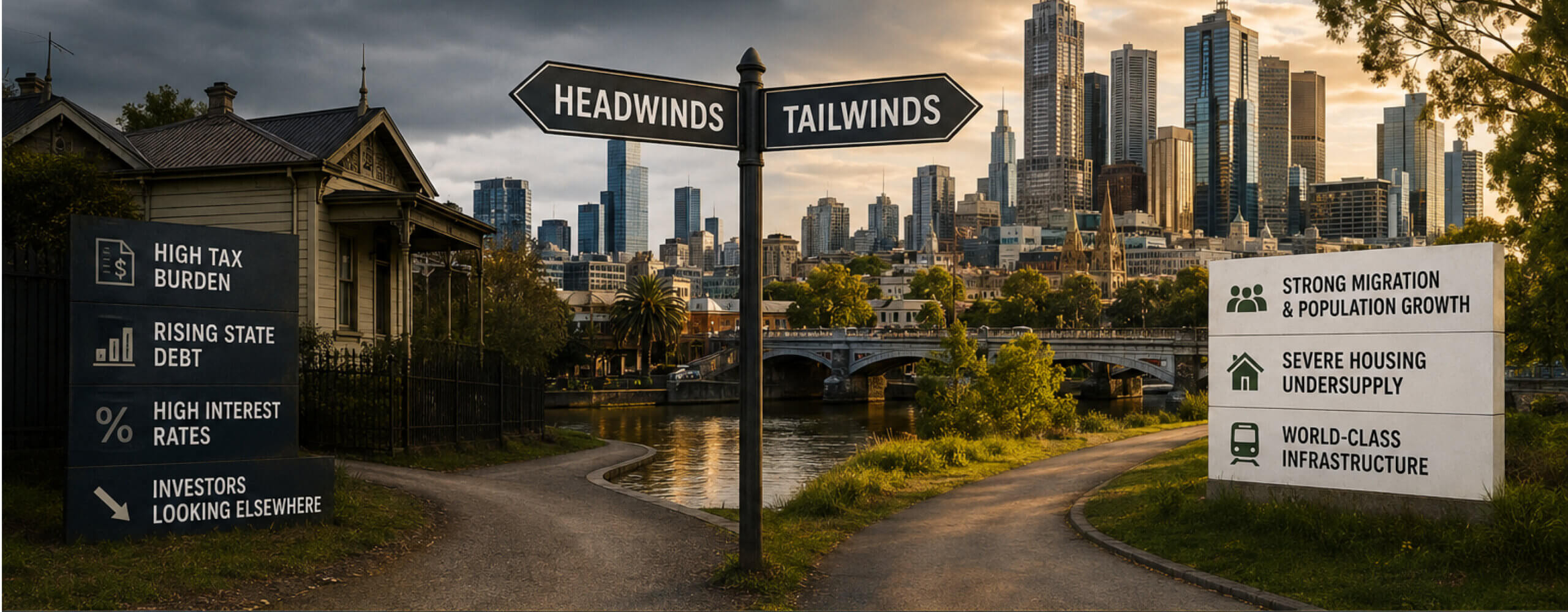
The trajectory of the Victorian property market through 2026 and into 2027 is shaped by a profound tug-of-war. On one side are powerful fundamental tailwinds – namely, surging migration and a critical need for housing infrastructure – and on the other are heavy macroeconomic and fiscal headwinds, including aggressive tax policies, stubborn interest rates, and mounting state debt.
While the state possesses the core ingredients for long-term prosperity, the current consensus points toward a near-term period of stagnation or slight contraction in Melbourne, operating firmly within a “two-speed” market dynamic.
The Landscape: Headwinds vs. Tailwinds
The Headwinds: Tax Burden and Fiscal Strain
Victoria’s broader fiscal position has placed a heavy anchor on market momentum, with state tax policy acting as a primary deterrent for property investors.
- Heavy Tax Metrics: According to the Parliamentary Budget Office, Victoria maintains the highest property tax revenue-to-Gross State Product (GSP) ratio nationwide.
- Aggressive State Budgets: The state budget forecasts land tax revenue to hit $6.5 billion (scaling toward $7.5 billion by 2029–30), alongside $10 billion in anticipated stamp duty. Meanwhile, the COVID Debt Levy on landholdings remains legislated to stay active until 2033.
- The “Anywhere but Melbourne” Phenomenon: Piled-on land taxes and high interest rates have heavily stifled investor participation. While Westpac projects a 34% national pullback in new investor activity, the sentiment is uniquely acute in Victoria, where capital is increasingly looking elsewhere.
The Tailwinds: Persistent Undersupply and High Demand
Despite policy friction, the state’s structural fundamentals remain robust, preventing any sharp structural collapse.
- Severe Housing Shortfall: KPMG data highlights that new dwelling supply over the next two years will track roughly 30% below the targets required to absorb accumulated housing deficits.
- Unabated Population Pressure: High levels of ongoing overseas and interstate migration continue to strain both the purchase and rental markets.
- World-Class Infrastructure: Melbourne’s established urban framework and continuous pipeline of major public transit projects preserve its long-term appeal for residents, even if cautious investors hesitate.
The 2026–2027 Forecast: A Divided Market
These opposing forces are channeling the market into a split personality:
- Near-Term Price Stagnation: Major forecasters like Westpac project flat or declining capital city price growth, anticipating an outright retraction of roughly -4% for Melbourne’s broader metrics.
- The Rise of the Two-Speed Market: Growth is heavily concentrated in lower price brackets and affordable segments. Affordability constraints are forcing a cultural shift among buyers, who are increasingly trading “backyards for balconies” and pushing units to outperform traditional detached houses.
What Needs to Happen for Victoria to Win?
For the Victorian property sector to transition from a restricted environment into a sustained positive trajectory, four structural shifts are required:
- Meaningful Tax Reform: Relying on bracket creep and escalating property values to mend the state budget continues to choke private investment. Easing land taxes and investor surcharges will be vital to lure capital back from rival markets like Brisbane and Perth.
- Stabilised Construction Costs: Delivery costs for new stock must find an equilibrium. High input costs currently dictate inflated starting prices for new builds, limiting the pipeline response needed to service migration demand.
- Interest Rate Relief: Broader market capacity relies on interest rate stabilisation or cuts to expand borrowing ceilings for both owner-occupiers and investors.
- Capitalising on the “Value Gap”: Because Melbourne property values have recently lagged behind northern and western capitals, a historically wide value gap has opened up. If tax settings adjust, Melbourne’s relative affordability compared to Sydney and its superior infrastructure could trigger a powerful wave of undervalued asset acquisition.
The Victorian property market is fundamentally sound at its core, propelled by real, unyielding demand. However, it remains heavily constrained by policy friction and debt. Unlocking its true potential will ultimately require an external catalyst – most notably, deliberate tax relief or monetary easing – to release the pent-up momentum waiting beneath the surface.